
Some Musings About Creativity (+ Two Poems)
Inspired by a friend, a podcast, some music, some poetry, and Autumn walks

A few weeks ago, a friend of mine, Josh Caliguire, posted about the ‘arch-nemesis’ of creativity: perfectionism.
I thought to myself, “Dang, me too.”
And at the end of his post he asked the question, “If there was no perfectionism holding you back, what would you be making?”
I’d probably write about how certain books or podcasts or albums have resonated with my introspective thoughts, which stumble through my mind and often fail to find their footing; maybe I’d write a little bit of poetry; and I might even include some photography, too.
So something like this, I guess.
Aside from reading, going on walks, the infrequent climbing session with some buddies, and hanging out with friends, I don’t have many hobbies.
And what you’ll notice among these four hobbies is that none of them are creative.
I’ve known for a few years now that I’m not a very creative person, but I haven’t done much about it. It’s not that I don’t have the capacity; it’s just something I’ve failed to practice.
Like Josh, I just can’t help but think to myself, often sub-consciously, “If I’m unable to create something that meets my creative standards, then why even bother?” Or, “If the process feels like a slog, then what’s the point?”
I first realized that this level of perfectionism isn’t exactly the norm in my freshman year writing class at CU. The very first reading we were assigned was an excerpt of Anne Lamott’s Bird by Bird entitled Shitty First Drafts, which, as you might infer, exhorts readers to write first drafts that are, quite simply, “shitty;” one can’t expect every first draft to be of good quality, although they may bring about unexpected clarity, or even brilliance. And without writing “shitty” first drafts, one can’t expect to iterate an improved second or third draft.
This was quite an epiphany for my 18-year-old perfectionist brain; it felt like I was given permission to do things poorly, at least to begin with. And although I know it to be true—that my first attempt at anything doesn’t have to be, and probably shouldn’t be, perfect—it’s something I have to remind myself of much more often than I would like to admit. Maybe it’s pride; maybe it’s insecurity; maybe it’s a lack of practice; maybe it’s the way my brain is, or has been trained;1 or maybe it’s some amalgamation of all of these.
So as I write this post, I’m trying my darndest not to comb through each paragraph for typos, grammar errors, and incorrect punctuation. (It doesn’t help that my mom was an english major!) I will confess, though, that I used a grammar checker a few times just to make sure I got some punctuation right; I’m still only like 75% confident with my usage of em-dashes and semicolons!
And while this epiphany may have helped my academic writing, which was still a slow process, it hasn’t quite influenced my personal creativity; something deeper would be necessary for that.
The first time I listened to episode one, Trust the Story, of The Bema Podcast was paradigm-shifting; Sabbath is now one of my favorite theological topics and spiritual practices to chat about, and, at this point, I gladly relate it to almost any conversation that I can, often to the point of sounding like a broken record.
Further, Andy Crouch’s conversation with John Mark Comer on The Rule of Life Podcast opened my eyes to how Sabbath relates to creativity, (and my lack thereof). In essence, Andy Crouch identifies the pattern of creation found in the Genesis 1: hovering, or contemplating the chaos of the not-yet-formed; speaking/acting/creating; beholding, or evaluating that which has been made; and resting.
This is no different from our pattern of creativity as image bearers, or at least how it ought to be. Unfortunately, Crouch notes that it is all too easy to find oneself stuck within a cycle of action and evaluation, which are important, yet leaving no room for contemplation and rest. And while he focuses more on the beginning act of contemplation in his discussion, like the Spirit hovering over the chaotic deep, what struck me most was his practice of rest at the end of his creative process, in which he flips to and reads a random page of an advance copy of one of his book and ruminates on just how awesome it is. Because on one hand, it’s too late for him to make any changes, and on another, Sabbath includes the “glad contemplation of work well done.”
Although I have excitedly injected this wisdom into multiple conversations with friends, I have struggled to gladly contemplate work well done because I often fail to reach that stage; even when I do write a poem or do something else creative, I find it difficult to know “when to say enough” and declare it to be good, much less awesome. There seems to be some form of creative inertia that has prevented my practice of creativity for far too long, even though I know that practice begets greater ability and (ideally) heightened enjoyment.
So I doubt you’ll be surprised to hear that I often lack fulfillment in this area of my life; I, as a bearer of the divine image, was created to partner with the ultimate Creator in the act of creation, yet often fail to partner with Him in this manner. This is a deep longing of my soul that I’ve allowed to fall to the wayside.
But dang it, I sure know how to appreciate some good art. And sometimes good art inspires mediocre (awesome) art (in my case).
Last year I supported Zach Winters’ Kickstarter for his latest album Shade of Indigo and poetry book Snowmelt to Roots. Z-Dub is far and away my favorite artist of the past few years, largely due to his wonderful songwriting, which so tenderly channels feelings and emotions into verse. I often find myself returning to his albums—front to back—as if returning home for feelings of deep homesickness, trusting that I’ll find respite.
And reading Z-Dub’s poetry for the first time was just plain sweet; I couldn’t help but delight in the simple profundity of even his shortest poems, some of which were excerpts of prayers.
Since reading Snowmelt to Roots for the first time just under a year ago, I’ve been inspired, just a few times, to write poems in times of prayer. Sometimes I’ve been moved by my beholding of nature; sometimes I’ve been moved by how I’ve beheld God’s character; and sometimes I’ve been moved by sorrow or spiritual destitution. However I’ve been moved to creativity in the form of poetry, it has been sweet to attempt to corral the chaotic waters of my thoughts and emotions with words. In doing so it feels like I’m taking after my Father.
And so, thanks to Josh, Andy, and Zach, here are two poems that I’m happy (trying) to call good, or even awesome.
5 O'clock, Eventide

an indigo sky—
alighting the horizon—
softly bounded
by the gradient
of day's fading light
and the slumberous shadow of eventide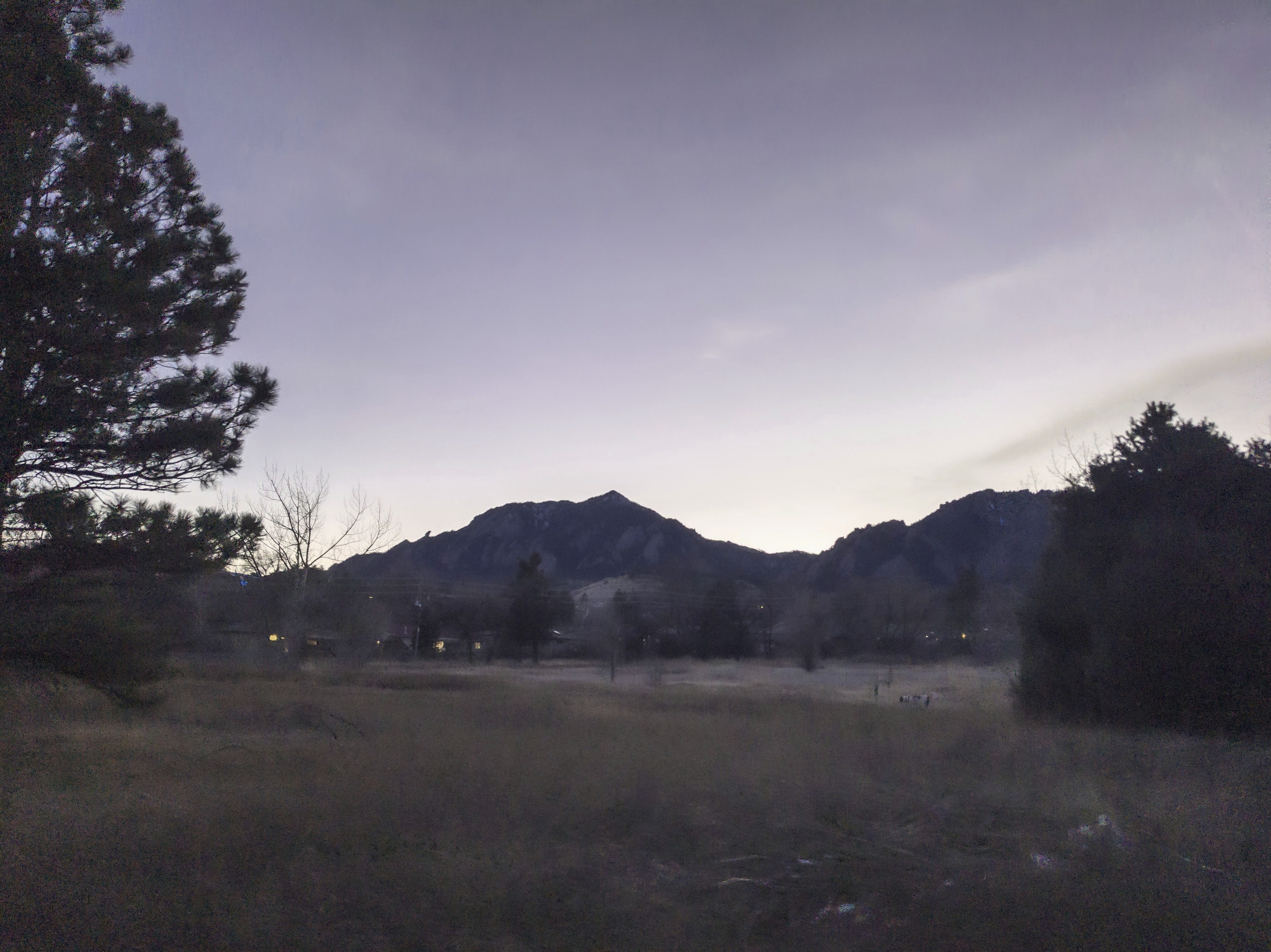
Gifts of Resonance

thoughts, feelings, emotions, verity
wistful and disorderly
chaotic and without form
yet harmonized by the words of others
who partner with He who spoke first
what sweet gifts of resonance!Throughout the course of college I noticed that many of my classes, and my subject preferences, reinforced my creative deficiency. I’ve always been good at math-related classes, and I think this is because I appreciate close-ended questions, or questions with just one solution. So throughout much of my schooling I trained my brain to work the system well and find the correct answer. This carried over to my studies of Sociology, where many of my classes were structured toward exams rather than seminars or open-ended papers. While there were a few papers in which I was able to apply theory in my own creative way, I largely utilized my ability to learn (“memorize”) and regurgitate answers or solve problems. As such, many of my Sociology courses were easy and led to a lack of actual learning. This was especially highlighted in my Data Visualizations course I took for my Data Science minor. This class required much more creativity than any of any other course I had taken—artistic creativity at that—as each project became increasingly open-ended, placing the creative vision on us students. And while I ultimately enjoyed this class, and especially this project, a ton, I felt totally lost and unimaginative at the beginning!
Max, this is super profound and there’s lots of wisdom here. I resonate a lot with finding it hard to call something “good” and contemplate it’s goodness as part of the act of rest, and Sabbath.
Proud of you homie! What’s your next article gonna be on?